
What if the most dramatic lift in your video ads isn’t what you add – but what you remove?
Short-form videos are so ubiquitous that marketers are rethinking how much text they need to include on screen. With Pippit and its AI storyboard generator, brands now have the chance to work smarter and question everything without having to recreate the wheel.
But that’s when text-free testing comes in, a data-driven approach utilized for comparing the text-heavy version with the text-free version of the same video to find what is most effective at moving the needle. Now, we should dig into why this approach works, what the data shows, and how the marketing world is leveraging it.
When less competes with more: The core idea behind text-free testing
“Most people in marketing were brought up with one rule: add words so everyone can read it faster,” says Adam Thomas and Chad Thomas. However, the modern platforms value something different altogether—watch time, retention, and a native feel.
Overlay-free testing challenges the assumption that overlays are always beneficial. Instead of asking “What text should we add?”, performance teams now ask:
“What if we add nothing at all?
Such a setup yields a clean, controlled experiment in which clarity, curiosity, and cognitive load are pitted against each other.
Two videos, one difference, real answers
Fundamentally, text-free testing compares:
- Version A: Moving images with titles, subtitles, callouts, or labels
- Version B: Same video, same edits, same audio—but no overlays.
Everything else remains the same:
- Period
- Opening hook
- Music or voiceover
- Audience targeting
- Budget and Placement
In doing so, this isolates text as the only variable, making opinion a measurable insight.
The psychology of watching vs. reading in feeds
When text becomes a speed bump
Text requires viewers to pause and process. In a fast-scroll environment, that pause can become costly. So many text-heavy videos create a lot of mental friction when the visuals are strong in themselves.
Where visuals lead, curiosity follows
Text-free videos rely on
- Accelerated Motion
- Faces
- He took action
- Emotion
Instead of explaining, they invite interpretation. This often leads to smoother viewing and higher completion rates.
Vanity numbers aren’t the only metrics that reveal the truth.
The three-second reality check
Text-free versions often perform better at early retention. Sans the screaming bold captions that say “AD,” they blend in much better into the feeds and improve thumb-stop rates.
Retention curves tell a big story
Data from A/B tests shows that:
- Fewer drop-offs in the first 25%
- More consistent mid-video engagement • Higher average watch duration Why? Viewers aren’t multitasking between reading and watching.
Conversion isn’t always about explanation
Ironically, ads with no text often perform better. A cleaner look comes across as more upmarket, less aggressive, and more trustworthy – particularly when promoting a lifestyle or creator or brand-driven marketing initiative.
Where text-free testing shines the brightest
Awareness campaigns that must feel human
In a brand lift and recall scenario, it keeps the focus on emotion and storytelling and away from selling language if overlays are removed.
Global campaigns without localization pain points
Creativity burnout solutions
Viewers desensitized to strong headlines tend to react when the stream appears to be smoother and more cinematic.
Where text still earns its spot
Text-free testing isn’t an issue of banning overlays. It’s an issue of deserving overlays.
Texts tend to do well when:
- Explaining prices and comparisons
- Short-term offers transmissions
- First-time user education
- Driving direct response actions.
The brightest groups don’t take sides, but test both.
From strategy to execution: Turning testing theory into action
Here’s what the actual problem is: execution cost. Testing without text traditionally involved editing whole videos. That quickly killed experimentation.
With modern editors found in the digital age, the ability to remove text from video with efficiency lets you go through the creative cycle quickly.
Which brings us to the practical ‘how’.
From hypothesis to clean canvas
After you have determined that you will testırı NG variants, it is time to act. Instead of creating assets, you will now utilize Pippit to quickly create clean variants.
The following is a simple and repeatable process that connects strategy and implementation.
Step-by-step: Producing text-free variants for Pippit
Step 1: Open the video editor
To extract text from a video AI free, you need to register for a free account on Pippit with your Google, TikTok, or Facebook login and select “Video Generator” or “Smart Tools” from the left menu. Then select “Video editor” and upload your video by dragging and dropping it into the box or clicking “Click to Upload” to upload it from your computer.
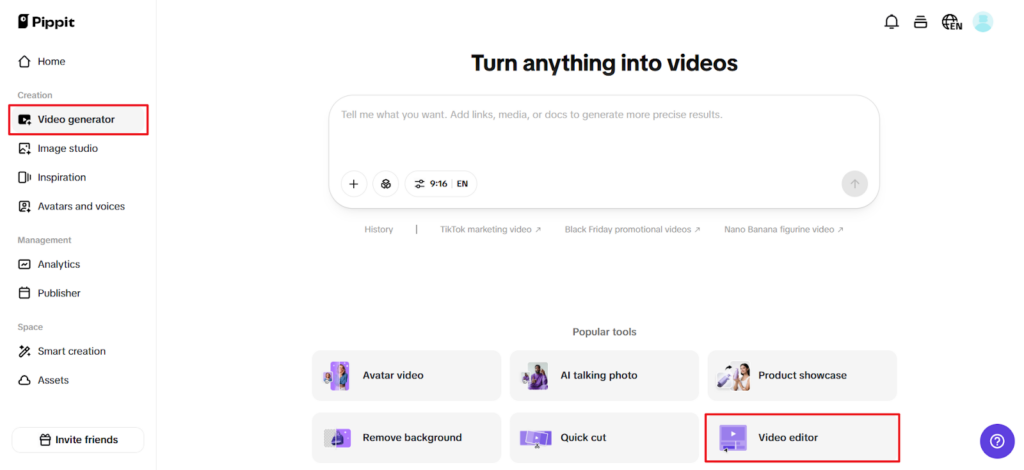
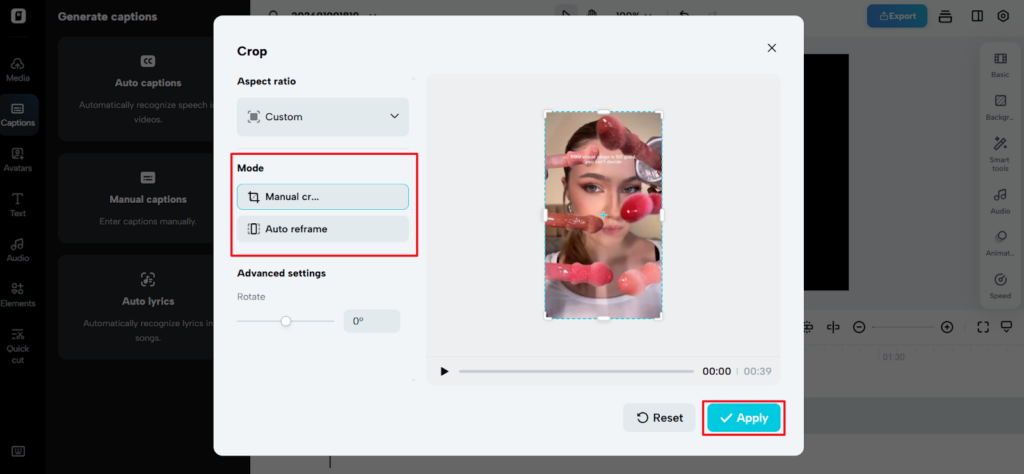
Step 2: Remove text from video
Select Smart Tools, then choose Auto Reframe from the menu. Set Aspect Ratio, select Manual Crop or Auto Reframe, and then apply trimming your video to your preferred dimensions while removing any watermark, typeface, or text.
You can also click Remove Background and turn the switch to Auto Removal to remove the background along with the text. Next, click Background and choose a solid color or move into Elements to place a free video or pic in the background, ideally using a transparent background maker process.
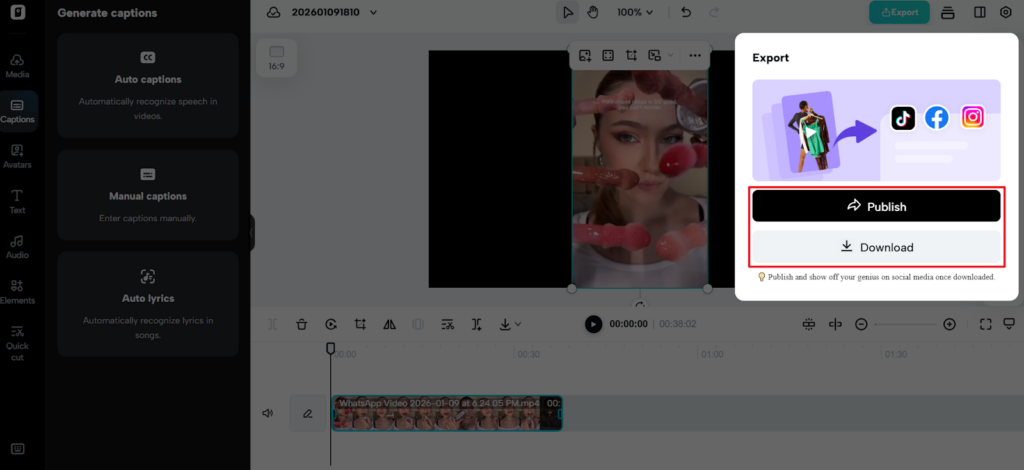
Step 3: Export & share video
Click the “Export” button located at the top right portion of the screen and select either “Publish” or “Download.” Determine the export settings by clicking the “Export” button to download the video to your computer.
Applying test results to facilitate more creative gameplay rules (not simply one-time successes)
The worst mistake marketers make is viewing A/B tests in isolation. Smart teams:
- Document which format works best without text
- Spot when overlays negatively impact retention
- Develop playbooks to address awareness vs. conversion stages
- Insights for use in future campaigns
Eventually, no-text testing becomes more about this video and then more about your visual language.
The real competitive edge: Testing faster than everyone else
In 2026, the creative advantage will be achieved by testing quicker, not by guessing better.
Through Pippit, the following things
- Reproduce several variants without creative redrafting
- Test text-heavy versus text-free at scale
- Let data—not habits—define what remains on screen
If you have always relied on the use of overlays, perhaps the time has come to challenge yourself with this very bold question: However, what occurs if instead we trust the visuals?
Get started with Pippit now and make text-free testing a part of your next breakthrough performance.