

Legacy systems are an important component of an organization’s core infrastructure that support core business functions and preserve a wealth of historical data that has accumulated over many years, in addition to representing a significant financial investment. Over time, however, it becomes increasingly complicated to manage, scale and secure legacy systems and therefore, modernizing those systems is no longer an option for organizations; it is a requirement. The primary challenge will be to modernize the legacy code while preserving the underlying business logic of how the organization operates. To solve this challenge, organizations should use AI to implement their modernization strategy.
The Risks Associated with Legacy Modernization
There’s a lot more than just rewriting code when it comes to modernizing your legacy systems; there are numerous risks to take into account when modernizing your legacy systems.
– There is a loss of undocumented business logic found in old coding.
– There could be a system downtime that impacts normal operations.
– There will be an inability to integrate with newer technologies.
– The costs and timelines can be very high, as well.
– Many traditional techniques usually depend on a heavy amount of manual analysis, which is slow and prone to errors.
How AI is Changing the Modernization Process
AI provides an innovative and effective method of updating legacy systems. AI tools used in legacy software modernization services will be able to analyze, understand, and help transform previous code into a new system rather than making teams build a completely new implementation of it.
1. Understanding Code and Creating Documentation
AI has the ability to scan large codebases and produce the necessary documentation automatically, helping teams produce their Documentation packages faster. These documents will contain:
- Function Descriptions
- How each piece of code integrates with the others in a system (i.e., Dependency Mapping)
- The flow of data in a system (i.e., Data Flow Mapping)
This is particularly helpful when the original developers are not available to create those documents.
2. Identifying Key Business Logic
One of the biggest fears when modernizing is that critical business logic will be lost. AI can identify the business rules embedded within an application’s conditional structures and enable you to map out how business logic is used and what relationships exist between modules.
3. Automated Refactoring
AI tools powered by artificial intelligence (AI) can perform automated refactoring processes, which include:
- Updating out-of-date syntax and making it conform to current programming standards
- Breaking apart a single application (known as a “monolith”) into several microservice-based applications
- Improving the maintainability and readability of an application’s code
4. Translating and Migrating Legacy Code
Artificial intelligence (AI) can help convert legacy programming languages (e.g., COBOL and VB6) to a current programming language (e.g., Java, Python and C#). The process will be much faster with the help of AI, but you still may need assistance from another person during the conversion.
5. Unit Testing / Integration Testing
AI will automatically generate unit and integration tests based on previous behavior of your original application, thereby allowing you to validate that the modernized version of your application has not changed from your original version.
Best Practices for AI-Supported Modernization
For efficient modernization, it’s better to follow best practices outlined below.
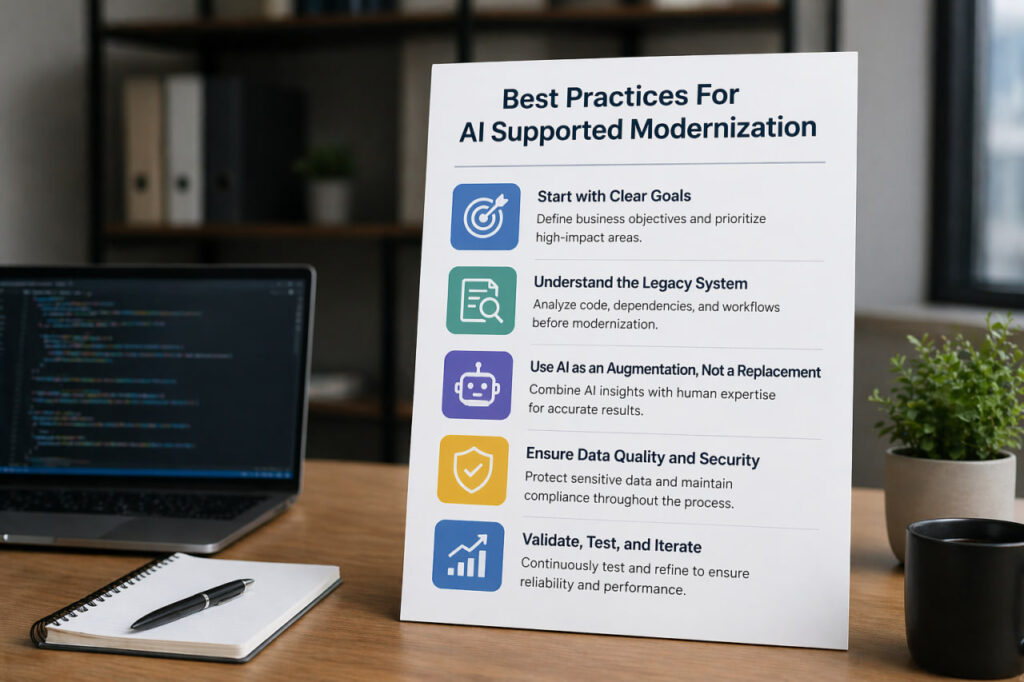
Begin with Assessment
A complete evaluation of your current systems should be completed. After evaluation, the following items should be identified:
- High-risk components
- Critical business modules
- Dependencies and integrations
For teams without in-house cloud architecture capacity, bringing in an AWS cloud consulting partner for this initial assessment can surface risks and dependencies that internal teams, too close to the system, tend to miss.
Utilize AI as an Augmentation Tool
AI will augment your engineers and will not replace them. Human beings will always be important in validating the accuracy of AI generated outputs, making architectural decisions regarding both system compatibility and enforcing security protocols.
Incremental Modernization
Risky to totally rewrite, therefore:
- Modernize piece by piece
- Use the strangler method to replace old components gradually
- Test continuously and verify the validity of the new components.
Preserve Business Logic First
Before changing any technology component and/or architectural framework, confirm that business logic exists for the following conditions:
- Business rules are clearly documented
- Behavior has been verified through testing
- High volume and low volume conditions exist and are clearly understood
Invest in Testing
Automated testing is essential. Therefore:
- Use automated testing of components generated by AI
- Utilize manual quality audits as part of the overall process
- Perform regression testing at the end of testing process.
Avoiding Common Pitfalls
While incorporating AI into your modernization efforts, there are many risks that can lead to failure. To help ensure success, don’t overlook any of the following risk areas:
- Over-reliance on AI – Always verify your results with human review and testing.
- Ignoring legacy nuances – Identify and preserve any hidden logic or edge conditions.
- Integration blind spots – In order to avoid failures, you must map out and/or test all integrations and dependencies.
- Inadequate documentation – Ensure that your documentation is easily understood, as this will help with future support of the application being developed.
- Weak Testing Strategies – Use a combination of AI-generated tests, regression and manual QA.
Examples From the Real World
One of the most recognised examples is JPMorgan Chase’s AI innovation through the COIN (Contract Intelligence) platform as an update to outdated, logic-intense legacy systems. Instead of completely rewriting the business application systems from the ground up, JPMorgan Chase was able to leverage machine learning to analyse complex financial contracts, a task that had historically been performed by legacy business application systems, Manual Review and, in some cases, lawyers.
The AI was able to:
1. Extract and analyse critical business rules from the documents
2. Reduce the time required to process the documents from approximately 360,000 hours annually to a matter of seconds
3. Increase accuracy and consistency of decision making
Another good example of this is IBM’s COBOL legacy code modernisation efforts. Using AI-based tools, IBM’s customers can analyse their COBOL legacy code and the business logic that has been embedded in those systems for decades, and then those customers can translate that logic to a modern programming language such as Java to enable their organisation to upgrade to a modern IT system while maintaining core business functions and capabilities.
Both of these are examples of how AI does not necessarily replace legacy systems; rather, AI assists businesses with understanding, preserving and evolving legacy systems in a manner that is secure and reliable.
Conclusion
Taking everything into account, AI can help with the upgrade of legacy systems without losing valuable business processes. Integrating AI into traditional technology adds speed and efficiency; however, humans using AI will provide expert judgment when using AI for validation purposes. When companies upgrade their systems using both AI and human experts, this transition should not only be a technology transformation but also improve how the organisation does business.