
AI help desk software has moved past the gimmick stage. In 2026, the useful features are the unglamorous ones: summarizing a 40-message ticket thread in a few seconds, suggesting tags so agents don’t have to, detecting the customer’s language, and drafting replies an agent can edit instead of writing from scratch. Teams that adopted these tools mostly report the same thing: agents spend less time on repetitive work and more time on the tickets that actually need a human.
The market is crowded, though, and vendors describe wildly different products with the same words. An AI ticketing system built for a five-person e-commerce support team has little in common with an enterprise IT service desk, even if both call themselves “AI-powered.”
This ranking compares eight of the best AI help desk software platforms available in 2026. For each one, we cover who it fits, what its AI actually does, and where it falls short, so you can match a tool to your team instead of buying the loudest marketing.
In a hurry? The short version:
- HelpDesk is the best overall pick for small and mid-sized teams.
- Intercom wins for chat-heavy SaaS.
- Gorgias wins for e-commerce.
- Zendesk fits large orgs with big budgets.
- Deskpro covers on-premise needs.
How we evaluated these platforms
We scored each tool on five things:
- AI features that save agent time. Summaries, drafting help, tagging, routing, and similar-ticket lookup. Chatbots alone didn’t count for much; plenty of products bolt on a bot and stop there.
- Automation depth. Can you build your own rules, or are you stuck with presets?
- Integrations. A help desk that doesn’t talk to your store, CRM, or dev tracker creates more work than it removes.
- Pricing transparency. Some vendors publish clear per-agent pricing. Others hide AI features behind add-ons or “contact sales” tiers.
- Fit for customer support vs. IT. Some tools are built for external customers, others for internal ai it helpdesk use. We flag which is which.
Pricing and feature sets change often in this category, so treat the details below as a starting point and confirm current terms on each vendor’s site before you commit.
1. HelpDesk
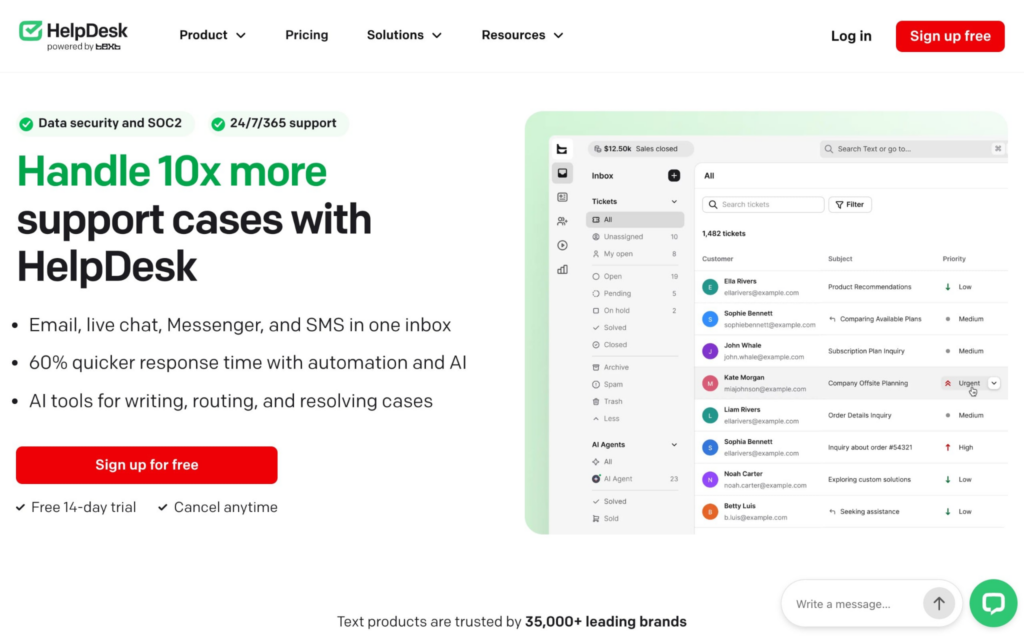
HelpDesk is the strongest all-around pick on this list for small and mid-sized support teams that want AI woven into the ticketing workflow rather than sold as a separate bot. You can see the full feature set on HelpDesk’s AI help desk page.
The AI shows up where agents actually spend their day:
- AI ticket summaries condense long threads so anyone can pick up a case without reading the whole history.
- Text enhancements let agents change the tone of a draft, expand a terse note into a proper reply, or fix grammar before sending.
- AI tag suggestions and language detection keep the queue organized automatically.
- Similar tickets surface past cases so agents can reuse solutions instead of solving the same problem twice.
Automation goes beyond the AI layer. HelpDesk ships with ready-made workflow templates and lets you build custom rules for routing, assignments, and follow-ups, which covers most of what smaller teams need from automated help desk software without a consultant.
Integrations include LiveChat, Shopify, Salesforce, HubSpot, Jira, and Zapier, so it slots into both e-commerce and B2B stacks. There’s a 14-day free trial with no credit card required, which makes it easy to test against your real ticket queue.
Best for: support teams of roughly 2 to 50 agents that want practical AI without enterprise pricing or a long setup. Watch out for: it’s focused on customer support. If you need a full ITSM suite with asset management and change control, look at Zoho Desk or a dedicated ITSM tool.
2. Zendesk
Zendesk is the incumbent, and it earns the position on breadth. Its AI agents handle common questions end to end, intent detection routes tickets by topic and sentiment, and agent copilot features suggest replies and next steps inside the workspace. The reporting is among the deepest in the category.
The trade-off is cost and complexity. AI features sit in higher tiers or paid add-ons, and pricing climbs quickly as you add them. Setup takes real time; small teams often end up paying for capability they never touch.
Best for: larger support organizations that need advanced routing, deep reporting, and a big app marketplace, and have the budget for it. Watch out for: the real price after AI add-ons, not the sticker price.
3. Freshdesk (Freshworks)
Freshdesk pairs a capable ticketing core with Freddy AI, which drafts replies, summarizes conversations, and powers self-service bots. A free tier and reasonable entry pricing have long made it a default choice for teams graduating from a shared inbox.
The catch is that Freddy’s more useful capabilities are add-ons priced per agent or per session on top of the base plan, so the real monthly cost is higher than the headline number. Some users also find the interface busier than it needs to be.
Best for: budget-conscious teams that want a well-known platform and are willing to do the math on AI add-on pricing.
4. Intercom (Fin AI)
Intercom bet the company on its Fin AI agent, and for automated resolutions it’s arguably the leading ai help desk for enterprise-scale conversational support. Fin answers customer questions from your docs and past conversations, and it resolves a meaningful share of routine chats without an agent. Pricing is partly per resolution, so you pay when the AI actually closes a conversation.
That model cuts both ways: high chat volume with lots of easy questions can get expensive, and Intercom is chat-first by design. Teams that live in email tickets may find it an awkward fit.
Best for: SaaS and product-led companies with heavy chat volume that want maximum bot deflection.
5. Zoho Desk
Zoho Desk brings Zia, Zoho’s assistant, into a ticketing product that costs noticeably less than most rivals. Zia handles sentiment analysis, reply suggestions, and anomaly alerts when ticket volume spikes. If your company already runs Zoho CRM, Books, or People, the native connections are a genuine advantage, and Desk works fine as an internal ai employee help desk too.
Zia is less polished than the AI in Zendesk or Intercom, and the interface feels dated in places. Support quality outside business hours draws mixed reviews.
Best for: teams already inside the Zoho ecosystem, or anyone prioritizing price over cutting-edge AI.
6. Help Scout
Help Scout takes the opposite approach to most of this list: it looks and feels like email, and its AI stays deliberately simple. AI summarize condenses threads, AI assist adjusts drafts, and AI drafts proposes replies based on your past conversations and docs. Customers never feel like they’re talking to a ticket number.
That simplicity is also the ceiling. There’s no deep workflow engine, routing is basic, and reporting won’t satisfy a data-hungry ops lead.
Best for: small teams that value a human, email-like experience and want AI as a quiet writing aid rather than an autonomous agent.
7. Gorgias
Gorgias is built for e-commerce, full stop. It connects deeply with Shopify, BigCommerce, and Magento, so agents see order data next to every ticket and can refund or edit orders without switching tabs. Its AI agent resolves common questions like “where is my order” automatically, and intent detection sorts the rest.
Outside e-commerce it makes little sense, and pricing is based on ticket volume, which punishes stores with seasonal spikes.
Best for: online stores, especially on Shopify, that want an ai chatbot for help desk work trained on order data.
8. Deskpro
Deskpro is the flexible one. You can run it in the cloud or on your own servers, which matters for organizations with strict data residency or compliance requirements. Its AI covers ticket summarization, reply drafting, and routing, and the platform handles customer support, internal IT, and HR queues in one system, including conversational HR helpdesk setups.
The downside of flexibility is effort: Deskpro rewards teams that invest in configuration and can feel heavy for a small support group that just wants to answer tickets.
Best for: organizations that need on-premise deployment or one platform for both customer-facing and internal service desks.
Quick comparison
| Tool | Best for | Standout AI feature |
| HelpDesk | SMB support teams | Ticket summaries + text enhancements in one workflow |
| Zendesk | Large support orgs | Intent-based routing and AI agents |
| Freshdesk | Budget-conscious teams | Freddy AI reply drafting |
| Intercom | Chat-heavy SaaS | Fin AI agent, per-resolution pricing |
| Zoho Desk | Zoho ecosystem users | Zia sentiment and anomaly alerts |
| Help Scout | Small, email-first teams | AI drafts from past conversations |
| Gorgias | E-commerce stores | Order-aware AI resolutions |
| Deskpro | Compliance-heavy orgs | On-premise AI help desk |
FAQ
What is AI help desk software?
It’s help desk software (some vendors spell it AI helpdesk software, others sell it as AI customer service software) with machine-learning features built into the ticketing workflow: automatic summaries, suggested or fully drafted replies, tagging, routing, language detection, and chatbots that resolve routine questions on their own. The goal is to cut the repetitive work out of each ticket, not to remove agents.
What’s the best AI help desk for IT support?
For internal ai for it help desk support, Deskpro and Zoho Desk are the strongest picks on this list because both handle internal queues, asset context, and employee-facing portals. Dedicated ITSM suites go further, but they cost more and take longer to deploy.
Can AI help desk software replace support agents?
Not yet, and the vendors that claim otherwise are overselling. Current AI reliably closes simple, repetitive tickets and speeds up everything else. Complex complaints, refunds requiring judgment, and angry customers still need people. The realistic outcome is a smaller share of agent time spent on routine work.
What should a small team look for first?
Three practical checks: whether the AI features are included in the plan you’d actually buy, whether it integrates with the tools you already use, and whether you can test it on real tickets during a trial. Agentic ai for help desk automation sounds impressive in a demo; what matters is how it behaves on your queue.
Bottom line
The right AI help desk depends on where your tickets come from. Chat-heavy SaaS teams should look at Intercom, Shopify stores at Gorgias, and compliance-bound organizations at Deskpro. For most small and mid-sized support teams, though, HelpDesk hits the best balance in 2026: AI that saves agent time on every ticket, automation you can configure yourself, and a trial that lets you verify both before paying anything.