
Search for a straightforward question on Google today, and you may get everything you need without opening a website. Definitions, instructions, comparisons, and AI-generated explanations increasingly appear directly in search results.
For businesses that relied on informational blog posts to attract potential customers, that’s been a devastating blow.
Ranking well for high-volume queries no-longer guarantees a steady flow of leads and customers.
But there is still a reason to invest in SEO.
The opportunity is shifting toward websites that help people accomplish something: calculate a result, create a document, investigate original research, or make a confident buying decision.
Those experiences give people a reason to go beyond the AI overviews.
Start with customer value, not traffic
This is the thinking behind what I’m building at RevPages: a tool that identifies valuable SEO opportunities, forecasts their potential revenue, and prioritizes them by commercial value and ranking potential.
The aim is to connect search activity with signups and revenue, rather than just trying to rank for every keyword within a particular topic.
A page attracting 300 relevant visitors who need your product now, will usually be more valuable than a general information page page attracting 10,000 readers with no intention of buying.
Before choosing a topic, ask three questions: Who would use this page? What would they accomplish? How does that task connect to the problem our business solves?
If the only answer is “this keyword gets searches,” keep looking.
What the zero-click research actually shows
SparkToro’s 2026 analysis, using Similarweb clickstream data, reported that 68.01% of U.S. Google searches in January through April 2026 ended without a click.
There is also evidence that AI summaries are associated with fewer visits to websites. Pew Research Center analyzed browsing data from 900 U.S. adults in March 2025. Users clicked a traditional search result in 8% of visits with an AI summary, compared with 15% without one.
These are different studies with different methods. Neither proves that every website will lose traffic, or that AI alone caused the difference. They do suggest that businesses should be cautious about relying on simple answers to generate visits.
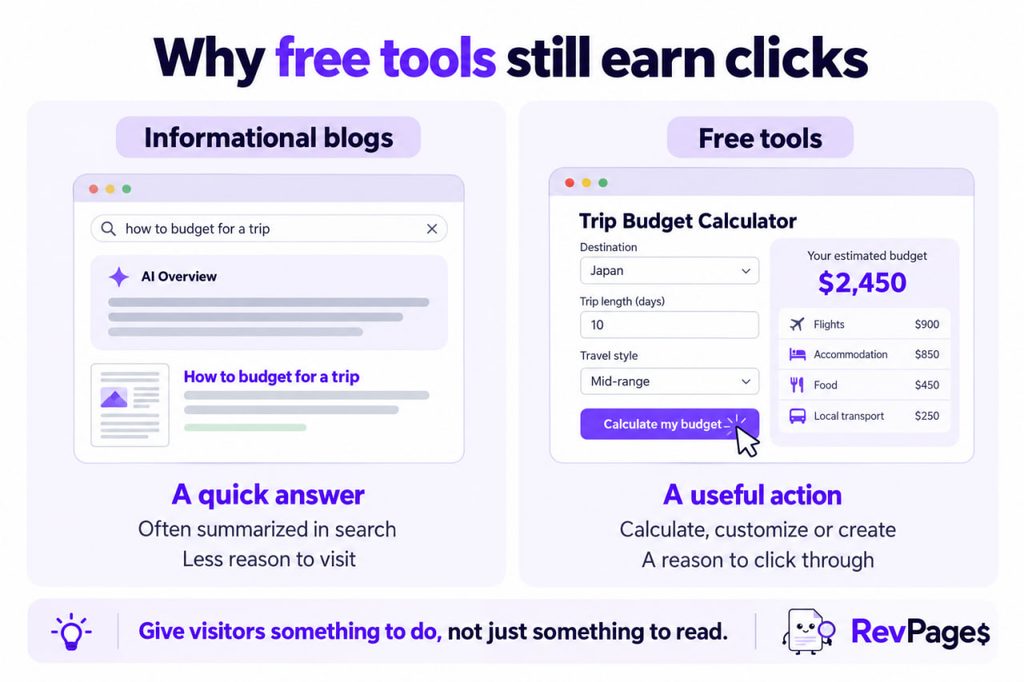
Informational content is particularly exposed when the entire value of a page can fit into a short explanation. A searcher asking what a conversion rate means may be satisfied immediately.
Someone who wants to do something more complex, like calculate the revenue impact of changing their own conversion rate – has a more involved task.
Create free tools connected to your offering
A useful tool turns general information into a result that depends on the visitor’s circumstances.
Instead of explaining a formula, it applies the formula, and gives the user an answer that is unique to their circumstances.
Instead of listing what a document should include, it helps someone produce the document.
This is why tools still drive clicks to websites.
The strongest ideas sit close to your paid offering
A payroll company could create an employee cost calculator. A project management platform could offer a capacity planner. An accounting firm could build a cash flow forecasting worksheet.
These resources attract people already dealing with a relevant problem. They also let visitors experience your approach before committing to a purchase.
A practical example: an SEO proposal builder
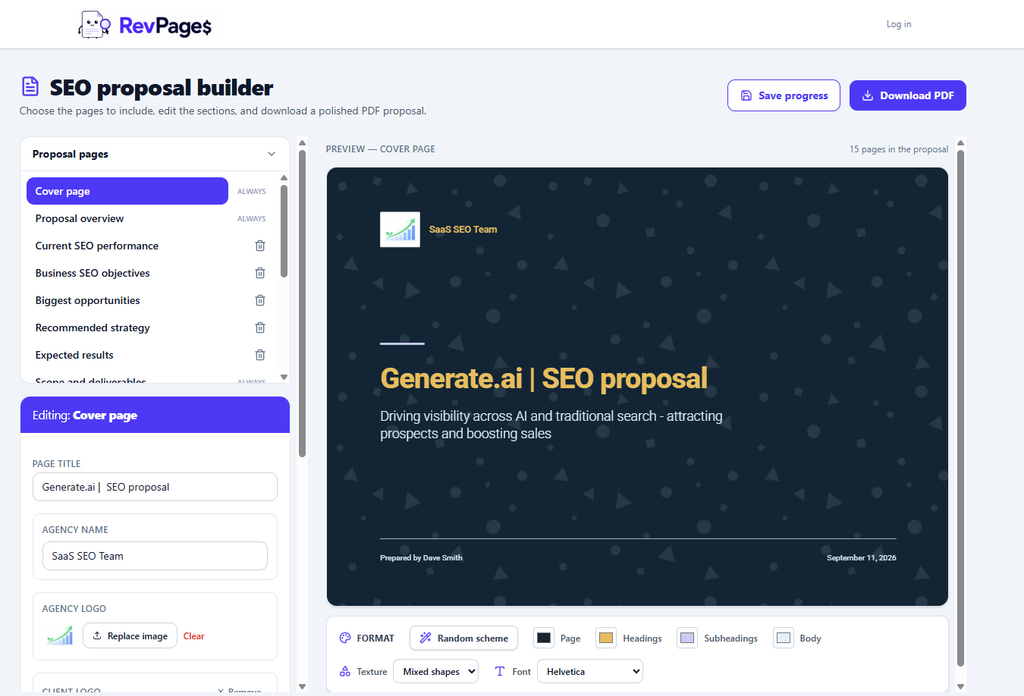
One example I’ve built is a free SEO proposal template and builder. It lets agencies and freelancers customize a proposal and download it as a PDF, rather than piece one together from a generic article.
The connection to the wider product is simple – people pitching SEO services also need to identify opportunities and plan the work they recommend.
From a search perspective, the page gives someone looking for a proposal template a practical reason to visit. Editable sections, pricing tables, and a finished download provide utility that a short search summary cannot fully reproduce.
That does not guarantee rankings or customers. The opportunity comes from matching the searcher’s task, offering a useful experience, and reaching an audience with a related commercial need. It still requires good execution, promotion, and measurement.
Make the result worth the effort
Keep inputs manageable, explain assumptions, and make the output immediately useful. If someone spends five minutes entering information only to encounter a mandatory sales call, the resource has probably failed them.
Let people experience the value first. An optional next step can then offer a relevant extension: save their work, analyze more scenarios, or solve the larger problem with your paid product.
Publish original data people can investigate
Original research gives your website something that competing articles cannot obtain by rewriting the same sources. It can also create reasons for journalists, creators, and industry publications to reference your work.
The important word is original. A collection of statistics from other websites can be convenient, but it does not make your business the source.
You could analyze anonymized product usage, survey a clearly defined audience, test a set of industry practices, or review public information using a consistent method. Choose a question your prospective customers actually need answered.
For example, a scheduling company might investigate how appointment reminder timing relates to attendance. A proposal platform might study which pricing structures appear in successful proposals. Both subjects connect naturally to the problems those businesses solve.
Make the methodology visible
Explain where the data came from, when it was collected, how large the sample was, and what was excluded.
If your customers supplied the data, say so: their behavior may not represent the whole market. Protect privacy and obtain appropriate permission before publishing sensitive information.
These details make the findings easier to assess and safer for others to cite. A striking number without a credible method is a weak foundation for authority.
Give readers more than a headline statistic
Search engines can summarize research too. Publishing data does not make a page immune to zero-click behavior.
Give visitors something beyond the main finding: a filterable benchmark, a downloadable dataset, detailed examples, or a calculator that applies the findings to their situation. A broad industry average might attract attention, while a comparison tailored to someone’s business gives them a reason to explore.
Keep the supporting content useful
Tools and studies still need explanation. Publish guidance that helps people understand their results, avoid common mistakes, and decide what to do next.
A calculator might need worked examples. A benchmark study might need a guide to interpreting small samples. A proposal builder might need advice on setting scope and presenting pricing.
This fits Google’s people-first content guidance, which encourages original information and substantial value beyond what other sources provide. Treat that as a quality standard, not a promise of rankings.
Make important information available as readable page text, use descriptive headings, and link related resources clearly. Check that pages work on mobile and can be crawled and indexed. A useful experience still needs to be discoverable.
Give customers a reason to return
One visit becomes more valuable when people return voluntarily. Depending on the task, that might mean saved calculations, an updated benchmark, an email briefing, or a reusable workspace.
For a resource people need regularly on their phones, a mobile app may also make sense. A platform such as AppsGeyser can help turn existing web content into an Android app. The useful question is whether the app makes a recurring task easier, not whether every business needs another distribution channel.
Promote resources where your audience already spends time, too. Share a useful finding in a relevant newsletter, demonstrate a tool in a video, or explain your research in an industry community. Each contribution should stand on its own while making the full resource easy to find.
Measure whether visitors become customers
Track the actions that connect usefulness with business value: tool completions, repeat visits, relevant signups, qualified inquiries, and eventual purchases.
Look beyond the last click. Someone may discover a study, return through a branded search, and buy weeks later. Analytics will not capture every influence, so combine attribution reports with customer feedback about how they found you.
Start with one recurring customer problem. Build the smallest genuinely useful resource that addresses it, publish supporting guidance, and improve it using real behavior.
SEO can still attract customers in the zero-click era. The strongest reason to keep investing is the opportunity to build a website people actively want to use, even when Google has already answered their first question.
Andrew Fenell is the founder of SEO revenue-planning platform RevPages with over 10 years SEO experience after founding, scaling and eventually selling CV builder SaaS platform StandOut CV.